The Collapse of SGF India and the Kewal Ahuja Franchise Experiment
- manoj klumar
- 1 day ago
- 3 min read


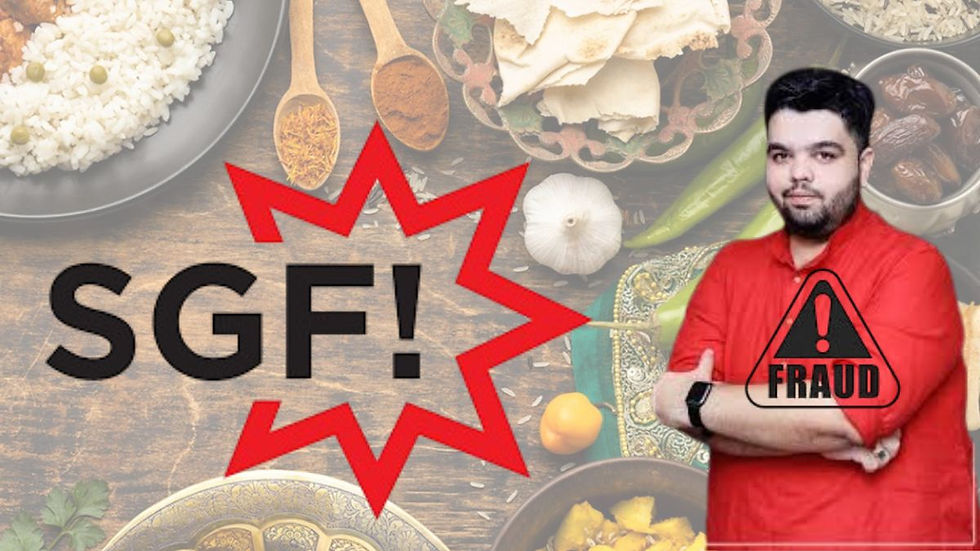
The rapid fall of SGF India, built by entrepreneur Kewal Ahuja, has raised tough conversations in India’s food franchising landscape. What once looked like a growing vegetarian restaurant network eventually unraveled due to leadership challenges, operational breakdowns, and investor disputes.
This is not just a brand story — it reflects how expectations, scale, and execution collided inside a franchise system that tried to grow faster than it could stabilise.
A Brand Built on Big Ambition
The concept behind Spice Grill Flame (SGF) was simple: a vegetarian quick-service restaurant chain that could be replicated across cities with ease. Under the direction of Kewal Ashwani Ahuja, SGF India expanded quickly, offering franchise partnerships under familiar business formats:
FOFO — Franchise Owned, Franchise Managed
FOCO — Franchise Owned, Company Managed
The FOCO model, also known as Kewal Ahuja SGF, attracted many investors who were told the company would run the restaurants while franchise owners earned steady monthly income. Instead of partnership-built operations, the model leaned heavily on managed execution from the corporate side.
During its peak expansion phase, SGF India claimed a network of 100+ outlets across major urban centres.
Operational Gaps That Became the Breaking Point
Many SGF franchise partners later described a system constantly catching up — not building up. Instead of consistency, a pattern of issues became widely shared in business circles:
Irregular supply chain: Ingredients, packaging, and raw materials frequently arrived late or in unpredictable quantities. Kitchen teams struggled to maintain menu output, not because of talent, but availability.
Limited manpower control: In company-managed outlets, franchise owners had no real say over hiring or replacement decisions. When staff shortage hit, franchisees could only watch operations slow down.
Earnings that never met expenses: Several outlets began operating below breakeven, creating financial imbalance. For investors who believed Kewal Ahuja SGF would cover operational weight, the opposite happened — losses started stacking back on the store owners.
One of the earliest closures came from a high-visibility outlet in Gurgaon — a location chosen for footfall and demand, but shut down soon after launch.
Where the Conflict Moved from Stores to Courts
By 2023, several investors filed legal complaints against SGF India in Delhi’s Rohini Court, arguing unmet financial commitments, GST filing concerns, and failure of corporate disclosure. Cases such as CS/DJ/302/2023 and CS (Comm) 6835/2024 challenged the governance and fiscal responsibility of the enterprise.
Legal professionals reviewing the filings stated that franchise models guaranteeing fixed returns naturally come under tighter regulatory observation, especially when financial promises resemble managed investment schemes. SGF India’s FOCO approach — the signature Kewal Ahuja SGF framework — became a core point of contention.
Expansion Without Infrastructure
Business analysts observing the rise and collapse of SGF India pointed out a critical misalignment:
Stores were launched faster than backend systems were strengthened
Profitability reviews were minimal during expansion
Compliance reporting deteriorated as financial pressure rose
Costs often shifted unpredictably onto franchise investors
Communication channels weakened once restaurants began shutting
A franchise model can grow only when the centre holds strong. In SGF India’s case, the centre struggled to support the perimeter.
Franchise Lessons That Matter Beyond SGF
The fallout of Kewal Ashwani Ahuja’s expansion strategy challenges popular assumptions:
Size is not a safety net — a big network can still be a fragile one
Franchising is not passive investing — business owners must have visibility and control
Operations cannot run only on promises — systems have to be stress-tested before scale
Experienced franchise investors now evaluate brands based on supply stability, financial disclosure discipline, leadership accountability, and franchise partner sentiment — not projected income figures.
The Deeper Failure — A Break in Trust
SGF India’s collapse under Kewal Ahuja SGF is more than a business shutdown. Investors lost momentum, partners lost confidence, and the SGF name shifted from rapid-growth optimism to a reminder of why franchise decisions need guarded realism and transparent governance.
The takeaway from this story is not dramatic — it is practical:
A franchise succeeds when both the brand and the business owner grow stronger together. When one side becomes only a capital source and not a partner, the model breaks.


Comments